
Most people assume you can just show up at a flight school, jump in a plane, and start training. That is not how it works. Before you ever fly an aircraft alone, you need a student pilot certificate, and many aspiring aviators are surprised to learn that this certificate is a legally required FAA document, not just a training school formality. Understanding what a student pilot certificate is, who qualifies, and what it allows you to do is the foundation of every successful aviation career. This guide walks you through every critical step.
Table of Contents
- Understanding student pilot certificate eligibility
- How to apply for your student pilot certificate
- Rules and limitations for student pilots
- Preparing for your first solo flight
- Medical certification and alternatives for student pilots
- Why many aspiring pilots misunderstand the student pilot certificate process
- Start your aviation journey with Parrillo Air Services
- Frequently asked questions
Key Takeaways
| Point | Details |
|---|---|
| Eligibility basics | You must meet minimum age and English proficiency to qualify for a student pilot certificate. |
| Application process | Apply online via FAA Form 8710-1 with ID verification and expect about 1-3 weeks for processing. |
| Operational limits | Student pilots cannot carry passengers, fly for hire, or operate internationally except specific routes. |
| Solo readiness | Before solo, you need training, proficiency endorsements, and a valid third-class medical or BasicMed. |
| Endorsement maintenance | Solo flight endorsements expire every 90 days and must be renewed to keep solo privileges. |
Understanding student pilot certificate eligibility
The student pilot certificate is the FAA's official entry point into the pilot certification system. It authorizes you to fly an aircraft solo under the supervision and endorsement of a Certified Flight Instructor (CFI). Without it, you cannot legally act as pilot-in-command, even for a single practice lap around the pattern.
So who qualifies? Eligibility requirements under 14 CFR §61.83 are straightforward but non-negotiable:
- Age: Minimum 16 years old for airplanes, helicopters, and gyroplanes. Minimum 14 years old for gliders and balloons.
- English proficiency: You must be able to read, speak, write, and understand English to ICAO (International Civil Aviation Organization) Level 4 or higher.
- Medical status: Any known medical limitations must comply with FAA medical certificate standards before solo flight is authorized.
- Citizenship and identification: You must provide proof of identity, age, and, in many cases, citizenship or immigration status.
What catches many students off guard is the English proficiency requirement. It is not just about being conversational. Air traffic control communication, written notices, and safety briefings all require precise language comprehension. If there is any ambiguity, a flight medical examiner may note it on your certificate, which imposes additional operating restrictions.
Flight training eligibility is worth reviewing in detail with your school before you invest time and money into the process. Knowing you qualify upfront removes one of the most common early frustrations.
How to apply for your student pilot certificate
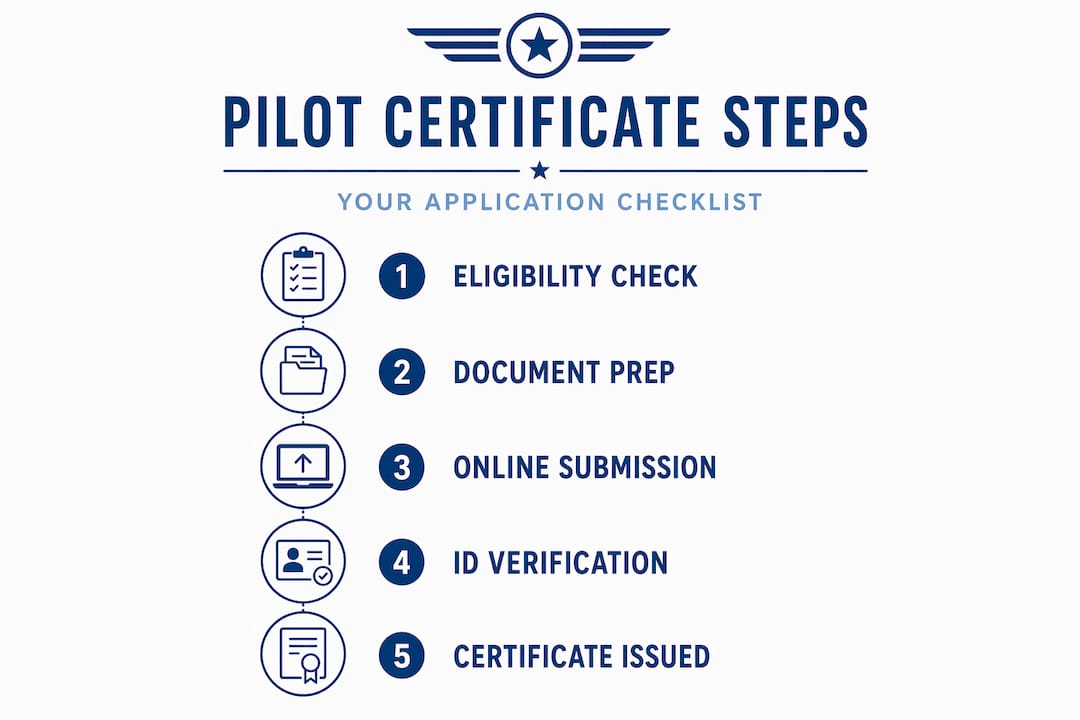
The application process is entirely digital through the FAA's IACRA system (Integrated Airman Certification and Rating Application). Here is exactly how it works:
- Create your IACRA account at iacra.faa.gov and generate your FAA Tracking Number (FTN). Save this number. You will use it for every FAA certification going forward.
- Complete FAA Form 8710-1 online. This is your official pilot certification application. Fill it out carefully. Name spelling must match your government-issued ID exactly.
- Schedule an in-person ID verification with your CFI, a Designated Pilot Examiner (DPE), or your local FSDO (Flight Standards District Office). Bring a valid photo ID, proof of age, and any available medical certificate.
- Receive your electronic signature and temporary certificate. This printable document is valid for 120 days while your physical card is being processed.
- Receive your physical certificate in the mail. Processing typically takes 7 to 21 days once your application is complete and verified.
The application process for pilots is more forgiving than many expect, but only if you prepare your documents correctly the first time.
Pro Tip: The single most common reason applications get delayed or rejected is a mismatch between the name on your IACRA application and your government-issued ID. Middle names, suffixes like "Jr.", and even a single transposed letter will flag your application for review. Triple-check before you submit.
Once you have your certificate in hand, whether temporary or physical, you are officially a student pilot. That said, holding the certificate does not mean you can fly alone yet. There are important operating rules to understand.
Rules and limitations for student pilots
The student pilot certificate comes with a clear set of operational boundaries. These are not suggestions. They are federal regulations under 14 CFR §61.89 and violations carry serious consequences, including suspension or revocation of your certificate.
Here is what you can and cannot do as a student pilot:
- Solo flights require a current instructor endorsement. Your CFI must physically sign your logbook before each solo session, and those endorsements expire.
- Carrying passengers is strictly prohibited. You fly alone, period.
- Flying for compensation or hire is not allowed. This includes anything of value exchanged for a flight, even informally.
- International flights are generally off limits, with a narrow exception for certain routes in the Alaska-Yukon region under specific conditions.
- You must hold at least a third-class medical certificate or valid BasicMed to act as pilot-in-command in powered aircraft.
"No person who holds a student pilot certificate may act as pilot-in-command of an aircraft that is carrying a passenger." — 14 CFR §61.89
Understanding these limits early is not discouraging. It is practical. Knowing what you can do helps you train with focus and purpose. Review the student pilot flight limitations in detail so nothing surprises you on the day your instructor steps out of the plane.
Preparing for your first solo flight
The first solo flight is the defining moment of early pilot training. But it does not happen until you meet a specific set of requirements under 14 CFR §61.87. Here is what that preparation looks like:
- Pass an aeronautical knowledge test administered by your CFI. This covers regulations, airport operations, weather, airspace, and emergency procedures.
- Complete all required flight maneuvers and demonstrate proficiency in each. For airplanes, this includes 20-plus maneuvers such as stalls, steep turns, emergency approaches, and crosswind landings.
- Obtain your logbook endorsements. Your CFI endorses your logbook for the specific make and model of aircraft you will fly solo. These endorsements are valid for 90 days.
- Secure your medical certificate before any solo flight in a powered aircraft.
Pre-solo requirements at a glance:
| Requirement | Details |
|---|---|
| Aeronautical knowledge test | Oral or written, administered by CFI |
| Flight maneuver proficiency | 20+ maneuvers for airplanes |
| Logbook endorsement | Make and model specific, valid 90 days |
| Medical certificate | Third-class or BasicMed for powered aircraft |
| Glider/balloon exception | No medical certificate required |
The solo flight training requirements are designed to confirm you are genuinely ready, not just willing. Your CFI is personally certifying that you have the judgment and skill to manage the aircraft without them in the right seat.
Pro Tip: Book your pre-solo knowledge test and flight review close together. Waiting too long between them means your 90-day endorsement may expire before you actually solo, and you will need to repeat the endorsement process. That costs time and money.
Glider and balloon students follow a modified checklist. The maneuver requirements differ, and the medical exemption means younger students and those with certain health conditions may find these categories more accessible early in their training.
Medical certification and alternatives for student pilots
Here is where many student pilots get confused. The medical requirements for student pilots are specific, and the rules differ depending on what you fly.
For powered aircraft, the rules are:
- A third-class medical certificate is required before your first solo flight.
- If you are under 40 years old, your third-class medical is valid for 60 months (5 years).
- If you are 40 or older, validity drops to 24 months (2 years).
- Gliders and balloons are fully exempt from medical certificate requirements.
The lesser-known option is BasicMed. Under the BasicMed program, you can act as pilot-in-command of a covered aircraft with a valid U.S. driver's license and a periodic physical exam from any state-licensed physician. No FAA aviation medical examiner required. The physician completes a checklist, you complete an online course, and you are cleared to fly.
Pro Tip: If you have any medical history that might complicate a standard FAA medical exam, consult an Aviation Medical Examiner (AME) for a Special Issuance evaluation before you begin training. Finding out your condition is manageable early avoids the devastating scenario of grounding yourself mid-training.
The pilot medical requirements page at your flight school or the FAA website will outline exactly which form to bring to your AME appointment and what documentation to prepare in advance.
Why many aspiring pilots misunderstand the student pilot certificate process
After working with student pilots from first inquiry to first solo, we have noticed a pattern. The paperwork is not what trips people up. The assumptions are.
Most new students think the student pilot certificate is essentially a permission slip that, once received, opens the door to solo flight. They are surprised to learn that the certificate is only the beginning. The 90-day endorsement clock, the pre-solo knowledge test, the make-and-model specificity of logbook endorsements, and the medical requirements all have to line up at the same time. If even one expires while you are waiting on another, you stop flying solo until it is renewed.
The pre-solo endorsement expiration is the single most avoidable setback we see. A student completes all their ground work, passes their knowledge test, feels ready, and then waits two weeks for a scheduling gap. The endorsement lapses. Now they need another logbook sign-off from their CFI before they can solo. It is frustrating, it delays the training timeline, and it is entirely preventable with a shared calendar and clear communication.
BasicMed is another gap in most students' knowledge. Many assume the only option is a formal FAA third-class medical exam. When we tell them a periodic check with their regular doctor qualifies under BasicMed, it changes their timeline and reduces their anxiety significantly. Check out our training program insights to see how we build these checkpoints into our structured training schedules.
The pilots who progress fastest are not necessarily the most natural flyers. They are the ones who treat the administrative side of training with the same discipline they bring to the cockpit. Know your endorsement dates. Know your medical expiration. Stay ahead of the paperwork, and the flying takes care of itself.
Start your aviation journey with Parrillo Air Services
If you are serious about turning that student pilot certificate into a private pilot license and eventually a professional aviation career, the quality of your early instruction matters more than most people realize.
At Parrillo Air Services, we specialize in exactly this stage of your training. Our FAA-certified instructors based in Lynchburg, VA guide you through every eligibility check, IACRA application step, pre-solo endorsement, and medical requirement. We do not leave administrative details to chance. Our flight training programs are designed around 14 CFR compliance, personalized pacing, and a clear roadmap from your first discovery flight to your private pilot certificate and beyond. If you are ready to take the first real step toward an airline career, we are ready to help you build it right from the start.
Frequently asked questions
What age do I need to be to apply for a student pilot certificate?
You must be at least 16 years old to apply for a student pilot certificate for airplanes, helicopters, or gyroplanes, or at least 14 years old for gliders and balloons.
Can I carry passengers as a student pilot?
No, student pilots cannot carry passengers during any solo operation. This restriction applies regardless of how much flight time you have logged.
How long does it take to get my student pilot certificate after applying?
Processing typically takes 7 to 21 days after submitting your application and completing in-person ID verification, with a temporary printable certificate available immediately.
Is a medical certificate required before my first solo flight?
Yes, a third-class medical or BasicMed is required before you fly solo in powered aircraft, though glider and balloon pilots are fully exempt from this requirement.
How often do solo flight endorsements expire?
Pre-solo endorsements expire every 90 days and must be renewed by your CFI before you can legally continue solo flight operations.