

Pursuing an FAA flight instructor certificate is one of the most career-defining decisions you can make as a pilot. The process is detailed, sometimes confusing, and easy to get wrong if you rely on secondhand advice. But it is also completely achievable with the right preparation. This guide walks through every critical step, from eligibility requirements to the checkride, so you know exactly where you stand, what comes next, and how to avoid the mistakes that derail other candidates. Whether you are building flight hours or preparing to teach full time, understanding this process gives your career serious momentum.
Table of Contents
- Core prerequisites for the flight instructor rating
- Logbook endorsements and knowledge test preparation
- Navigating the FAA practical test (checkride)
- Verifying your rating and common pitfalls
- What most guides miss about the flight instructor rating process
- Take your next step with Parrillo Air Services
- Frequently asked questions
Key Takeaways
| Point | Details |
|---|---|
| Eligibility matters most | You must meet strict FAA prerequisites before applying for any flight instructor rating. |
| Endorsements are required | Logbook endorsements for FOI and Areas of Operation are mandatory for knowledge test and practical test eligibility. |
| Checkride is not just flying | Passing the FAA instructor practical test requires teaching and managing skills, not only maneuver demonstrations. |
| Rating process is individualized | Each instructor rating has specific requirements and ACS-based benchmarks—there’s no universal ‘CFI ladder’ approach. |
| Strategic prep pays off | Successful candidates plan around examiner objectives and regulatory standards, not just rote training steps. |
Core prerequisites for the flight instructor rating
Before you log a single hour toward instructor training, you need to confirm that you actually meet the FAA's eligibility standards. Skipping this step is one of the most common and costly mistakes candidates make. The regulations are rating-specific, which means the exact requirements shift depending on which instructor certificate you are pursuing.
According to 14 CFR 61.183(a)-(c2), FAA eligibility starts with four foundational prerequisites: age, English proficiency, the appropriate pilot certificate and class, and an instrument rating where applicable. Each one is a hard stop. If you fall short on any single item, your application will not move forward.
Here is a breakdown of each prerequisite and how it affects your timeline:
- Age: You must be at least 18 years old. This is firm and has no exceptions.
- English language: You must be able to read, speak, write, and understand English. This is not a test, but it is a regulatory requirement with real consequences.
- Pilot certificate: You must hold at least a commercial pilot certificate or an airline transport pilot (ATP) certificate in the appropriate category and class for the instructor rating you seek.
- Instrument rating: For most airplane and powered-lift instructor ratings, you need instrument rating privileges. The exact requirement depends on the specific category and class of aircraft.
- Pilot-in-command hours: Per 61.183(j), minimum 15 hours PIC in the relevant category and class is required before the practical test.
The 15-hour PIC requirement deserves particular attention. It is not just about total flight time. The hours must be logged specifically as pilot in command in the same category and class you intend to instruct. If you are pursuing a flight instructor certificate for single-engine airplanes, those 15 hours must be in single-engine aircraft, logged as PIC.
| Prerequisite | Minimum requirement | Notes |
|---|---|---|
| Age | 18 years | No exceptions |
| Pilot certificate | Commercial or ATP | Must match category/class |
| Instrument rating | Required for most airplanes | Verify for your specific rating |
| PIC hours | 15 hours in category/class | Must be in applicable aircraft |
| English proficiency | Read, speak, write, understand | Regulatory requirement |
Knowing these numbers early lets you build a realistic timeline. Most candidates pursuing a flight training overview path through commercial to instructor can complete the PIC hours requirement during their commercial training, which makes the overall journey smoother.
With prerequisites understood, it is time to prepare for the first official steps in the certification process.
Logbook endorsements and knowledge test preparation
Endorsements are the foundation of the instructor certification process, and the FAA does not leave them to interpretation. Under 61.183(d) and 61.183(g), two logbook endorsements are required before your rating is issued: one for the Fundamentals of Instructing (FOI) and one for the Areas of Operation applicable to your instructor rating.
Your endorsements must come from an authorized instructor. That means a current certificated flight instructor (CFI) who reviews your knowledge and signs off that you are prepared. The FOI endorsement covers teaching theory, learning principles, and human behavior in training environments. The Areas of Operation endorsement confirms that a qualified instructor has reviewed your aeronautical knowledge in each task area relevant to your rating.
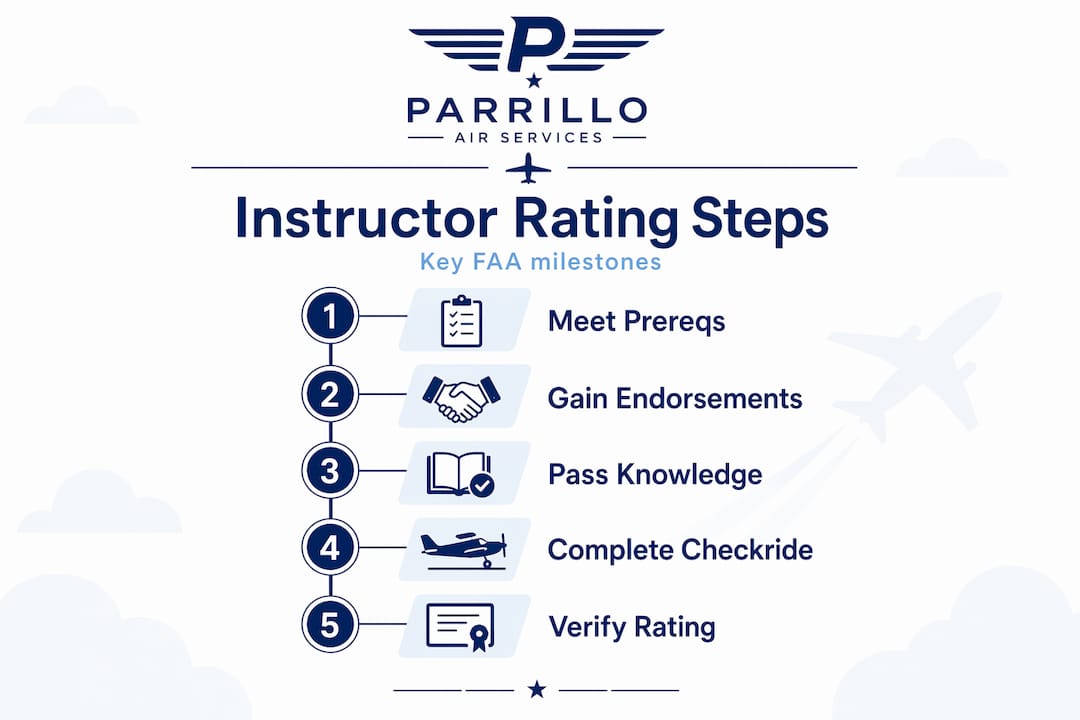
Here is the step-by-step path from endorsements to knowledge test clearance:
- Identify your authorized instructor. This person must hold a current CFI certificate and be willing to provide ground instruction in both the FOI and applicable aeronautical knowledge areas.
- Complete FOI ground training. Study teaching methods, the learning process, and effective communication. Your instructor will confirm your readiness.
- Complete aeronautical knowledge ground training. Cover every area of operation listed in the relevant ACS or PTS document for your rating.
- Receive written logbook endorsements. Both endorsements must be in your logbook before you can register for the knowledge tests.
- Schedule and pass the FOI knowledge test. This is a separate test from the aeronautical knowledge exam.
- Schedule and pass the aeronautical knowledge test. Study knowledge test info and use FAA test prep materials aligned with the current ACS.
Under 61.183(e) and 61.183(f), candidates must pass both the FOI and aeronautical knowledge tests unless they qualify for an exemption. The FOI exemption is an important edge case. If you hold a valid ground instructor certificate, a valid flight instructor certificate, or meet specific requirements tied to teaching credentials, you may qualify to skip the FOI test entirely.
| Path | FOI test required? | Aeronautical knowledge test required? |
|---|---|---|
| No prior certificates | Yes | Yes |
| Holds current CFI certificate | No (exempt) | Yes |
| Holds ground instructor certificate | No (exempt) | Yes |
| Holds only student/private/commercial cert | Yes | Yes |
Pro Tip: Verify your FOI exemption status before paying for test registration. The FAA's exemption rules are straightforward, but many candidates waste time and money testing when they were never required to in the first place. Ask your instructor or check directly with the FAA's Airman Certification Branch.
Once you have secured endorsements and prepared for the knowledge tests, you will move toward the practical evaluation phase.
Navigating the FAA practical test (checkride)
The checkride is the most demanding part of the instructor certification process, not because it is impossible, but because it requires you to perform two jobs at once. You need to demonstrate that you can fly well and that you can teach someone else to fly. Those are different skills, and examiners are trained to spot candidates who only prepared for one of them.

Under 61.183(h), the FAA practical test is required for all instructor certifications without exception. The checkride is structured around the Airman Certification Standards (ACS) or Practical Test Standards (PTS), depending on the specific certificate. These documents define exactly what the examiner will evaluate and how performance will be measured.
According to the FAA ACS/PTS rules, practical testing is evaluated across three dimensions for every task: knowledge, risk management, and skill. That three-part structure matters. You cannot pass the checkride by flying perfectly if your risk management explanations are weak. And you cannot pass by explaining things beautifully if your aircraft control is outside standards.
The FAA ACS library provides current ACS documents for all flight instructor rating variants. Download the applicable document before you begin checkride prep. Treat it as your study guide, not a background reference.
Here is what successful candidates focus on in their checkride preparation:
- Teach-and-manage demonstrations: For most tasks, the examiner will play the role of a student pilot. You must explain the concept clearly, set up the maneuver, and manage the scenario as though you are conducting a real lesson.
- Risk management narration: You need to verbalize your decision-making process in real time. Examiners look for candidates who identify hazards out loud, not just avoid them quietly.
- Precise aircraft control: You are still expected to fly within ACS tolerances. Teaching during a flight does not lower the performance standards.
- Lesson planning: Some checkrides include a ground portion where you present a structured lesson plan for a specific topic.
"The flight instructor checkride is unlike any other practical test in aviation. It is not just a performance evaluation. It is a teaching evaluation conducted inside an airplane. Candidates who prepare only for the maneuvers are almost always the ones who leave the examiner unsatisfied."
Pro Tip: Record yourself delivering a mock lesson before your checkride. Watching the playback reveals habits you cannot detect while you are in the moment, including filler words, poor pacing, and incomplete explanations of risk factors.
The best ACS preparation strategies combine ground rehearsal with flight practice. Review each ACS task, write out your teaching explanation, practice it verbally, then fly the task while narrating. Repeat until it feels natural. For additional checkride tips, work with an instructor who has recent checkride experience and can give you honest feedback.
Verifying your rating and common pitfalls
Once the checkride is passed, the process shifts to verification and documentation. This phase is shorter but still requires attention. A single missing endorsement or outdated document can delay issuance of your certificate.
Use this checklist before submitting your application:
- All required logbook endorsements are present: FOI and Areas of Operation endorsements must both be in your logbook, dated and signed by a qualified instructor.
- Knowledge test results are valid: FAA knowledge test results expire after 24 months. If your test was taken more than two years ago, you need to retest.
- Medical certificate is current: You need at least a third-class medical certificate to exercise flight instructor privileges.
- Hours are logged accurately: PIC time in the applicable category and class must be clearly documented. Sloppy logbook entries can trigger questions from the examiner or the FAA.
- ACS version used during training is current: Examiners use the latest published ACS. If your preparation was based on an older version, gaps may appear during the oral exam.
One of the most persistent misconceptions in the instructor certification world is what some instructors call the "CFI ladder," where you earn a basic CFI, then add on instrument and multiengine instructor ratings in a fixed sequence. While that path is common, the regulatory steps are actually rating-specific and individualized, not a simple staircase. Each instructor rating has its own prerequisites, its own ACS, and its own practical test. The ladder concept is a training industry shorthand, not a regulatory framework. Build your path around the actual requirements for the specific rating you want, not someone else's training sequence.
Strong FAA instructor rating guidance always starts with the regulation itself, then works backward to build a personalized preparation plan.
What most guides miss about the flight instructor rating process
Most articles about flight instructor certification read like a numbered checklist pulled directly from the CFR. And while regulations are the backbone of the process, treating the process as a checklist is exactly where many candidates run into trouble.
Here is what we have learned from working with instructor candidates: the biggest differentiator between candidates who pass on the first attempt and those who do not is not hours, it is orientation. Candidates who orient their preparation around ACS task objectives consistently outperform those who orient it around maneuver repetition.
The "teach-and-manage" demand of the checkride is genuinely different from every other practical test in aviation. In a private pilot checkride, you perform. In a flight instructor checkride, you perform and explain, often simultaneously, while managing an examiner playing the role of a struggling student. That combination trips up even pilots with excellent stick-and-rudder skills. Focusing on teach-and-manage tasks is more effective than memorizing maneuvers, and the ACS evaluation confirms that every task demands all three pillars: knowledge, risk management, and skill.
We also want to challenge the common assumption that more total flight hours equal better checkride readiness. Hours matter for meeting minimums, but beyond the minimums, depth of ground preparation and teaching fluency are what move the needle. A candidate with 300 hours who has rehearsed every ACS task as a lesson will almost always outperform a 600-hour pilot who has not thought about how to explain what they are doing.
Personalized preparation is not just a feel-good phrase. It is the practical shortcut. When you work with an instructor who knows the current ACS, knows your weak areas, and structures your lessons around closing those gaps, you spend less time spinning and more time progressing. That is the kind of expert perspectives that actually changes outcomes.
Take your next step with Parrillo Air Services
Understanding the regulatory path to your flight instructor certificate is the first step. Getting there requires structured training, detailed feedback, and instructors who prepare you for the actual checkride standard.

At Parrillo Air Services, our flight training programs are built around FAA Part 61 requirements and designed to move you through each rating efficiently. We work with candidates at every stage, from first endorsements to checkride preparation, with instruction that reflects the current ACS standards. Explore our student support area to access resources, connect with our team, and get a clear picture of what your instructor rating journey looks like with professional guidance behind you.
Frequently asked questions
What is the minimum age to become an FAA flight instructor?
You must be at least 18 years old to apply for any FAA flight instructor certificate. There are no exceptions to this requirement.
Do I need an instrument rating for every flight instructor certificate?
Not every rating requires it, but instrument privileges apply to most airplane instructor certificates, so verify the specific requirement for your intended category and class before beginning training.
Can I skip the FOI knowledge test if I'm a teacher or already have a relevant certificate?
Yes, certain candidates qualify for a FOI test exemption based on an existing flight instructor certificate or ground instructor certificate, so confirm your eligibility before registering for the test.
What does the FAA practical test (checkride) evaluate?
The checkride measures your ability to teach, manage risks, and demonstrate skills across every applicable ACS task, with all three dimensions evaluated for every item on the test.