

One overlooked document, one missed deadline, and your path to the cockpit can stall for weeks or even months. Thousands of aspiring pilots discover this the hard way every year, losing time and money before they ever leave the ground. This guide walks you through every step of getting your FAA student pilot certificate, from confirming eligibility to submitting your application through the IACRA system, understanding medical timing, and dodging the mistakes that trip up beginners. Follow this process and you will start your training without unnecessary interruptions.
Table of Contents
- Eligibility and prerequisites for a student pilot certificate
- Step-by-step application process: Using IACRA and Form 8710-1
- Timing, medical certificate validity, and renewal
- Common pitfalls and troubleshooting tips
- What most guides get wrong about starting your pilot journey
- Next steps: Structured flight training with Parrillo Air
- Frequently asked questions
Key Takeaways
| Point | Details |
|---|---|
| Check eligibility early | Review age, language, and medical requirements before starting any application. |
| Apply online with IACRA | Using the FAA’s electronic system speeds up application and reduces errors. |
| Get medical certificate first | Secure your medical qualification before paying for flight training to prevent costly delays. |
| TSA clearance for non-citizens | Non-U.S. citizens must obtain TSA approval prior to any FAA-regulated flight training. |
| Stay ahead on renewals | Medical certificates expire based on age—plan ahead to keep flying solo. |
Eligibility and prerequisites for a student pilot certificate
Before you touch anything in the application system, you need to know whether you qualify. The FAA sets clear baseline rules, and flight training prerequisites are not complicated once you understand the framework.
Age requirements are the first checkpoint. 14 CFR 61.83 states that eligibility requires a minimum age and English proficiency. Specifically, you must be at least 16 years old to fly powered aircraft like airplanes and helicopters solo. If you plan to fly gliders or balloons, the minimum age drops to 14. You do not need to be a certain age just to begin ground training or enroll in a program, but you must meet the age threshold before flying solo.
English language proficiency is a requirement that surprises some applicants. You must be able to read, speak, write, and understand English. If you have a medical condition that limits your English ability, the FAA may place operational restrictions on your certificate. This is not an outright disqualification in every case, but it is a nuance we will cover more thoroughly in the troubleshooting section.
Medical certification is arguably the most important box to check first. You must meet medical qualification requirements.pdf) before flying solo. A third-class medical certificate (the minimum required) is issued by an FAA Aviation Medical Examiner (AME). Schedule this before spending money on flight lessons because certain medical conditions can disqualify you from solo flight, and it would be painful to pay for training hours before finding that out.
Non-U.S. citizens face an additional step. If you are not a U.S. citizen or national, federal law requires you to obtain a TSA Security Threat Assessment before beginning regulated flight training. This process involves submitting fingerprints and personal information to the TSA for a background check. Processing times vary, so start this well before your intended first lesson.
Here is a quick summary of what each applicant type needs before applying:
| Applicant type | Minimum age | Medical certificate | TSA clearance |
|---|---|---|---|
| U.S. citizen, powered aircraft | 16 | Third-class or higher | Not required |
| U.S. citizen, glider/balloon | 14 | Required for solo | Not required |
| Non-U.S. citizen, powered aircraft | 16 | Third-class or higher | Required before training |
| Non-U.S. citizen, glider/balloon | 14 | Required for solo | Required before training |
Key prerequisites at a glance:
- Proof of age (government-issued ID or birth certificate)
- English proficiency (assessed during AME visit or by your instructor)
- Valid third-class medical certificate (or higher)
- TSA Security Threat Assessment approval (non-U.S. citizens only)
- No criminal record disqualifications under TSA regulations
Pro Tip: Schedule your AME appointment before enrolling in a structured flight program. If a medical issue surfaces, you can address it early instead of discovering it mid-training when you have already spent significant money on lessons.
"The student pilot certificate is the entry point to your aviation career. Getting your medical sorted first is not just bureaucratic housekeeping — it is smart risk management that protects your time and your investment." — Parrillo Air instructor team
The FAA training overview shows how these prerequisites connect to the broader certification pathway. Understanding where the student certificate fits in the larger picture helps you plan with a long view.
Step-by-step application process: Using IACRA and Form 8710-1
With your eligibility confirmed, let's get hands-on. Here is how you actually apply.
The FAA uses an online platform called IACRA (Integrated Airman Certification and Rating Application) to process most pilot certificates. The application flow is handled electronically through IACRA, with a paper fallback available for situations where electronic submission is not possible. The online route is faster, more reliable, and preferred by the FAA.
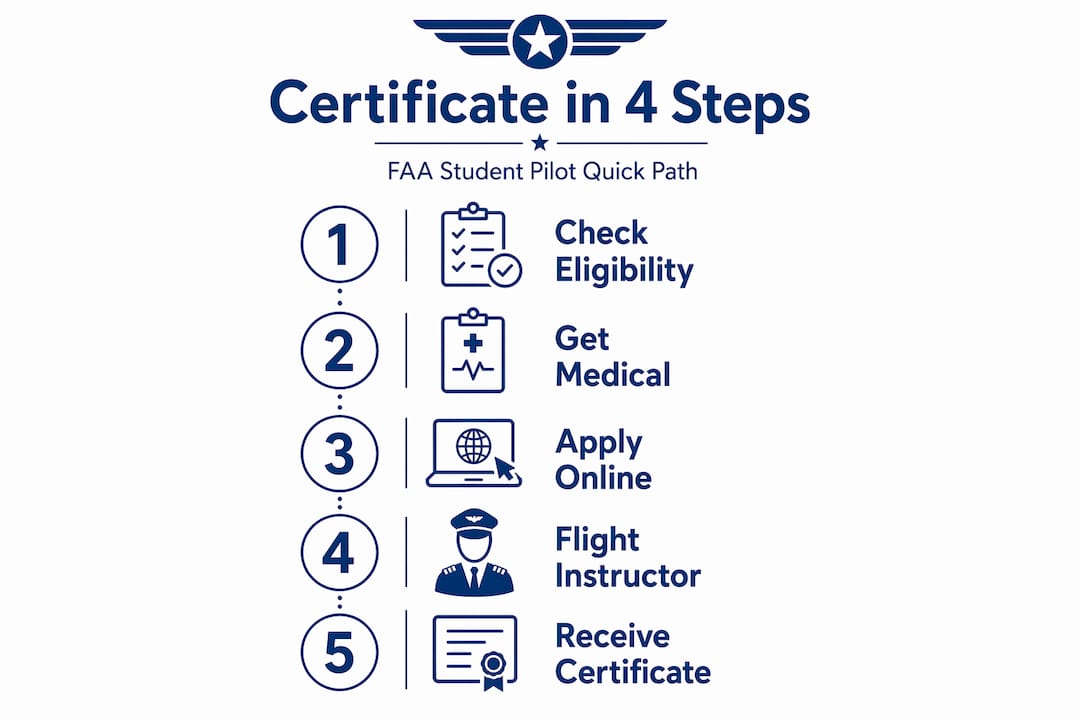
FAA Form 8710-1 instructions strongly encourage online submission via IACRA rather than paper. The paper version still exists and your flight school can walk you through it if needed, but for most applicants the student pilot application steps begin and end online.
Here is the full application process, step by step:
- Create your IACRA account. Go to the FAA's IACRA website and register with a valid email address. You will receive a login and a unique FAA Tracking Number (FTN). Write this number down. It follows you through your entire aviation career.
- Complete your personal information. Fill in your legal name (exactly as it appears on your government ID), date of birth, address, and citizenship status.
- Select application type. Choose "Student Pilot Certificate" from the application menu. If you are a non-U.S. citizen, the system will prompt you for TSA clearance information.
- Enter your medical certificate information. Input your medical certificate number, date of issuance, and the class of certificate you hold.
- Submit to your flight instructor for review. Your designated flight instructor (CFI) reviews and electronically co-signs your application. This is a required step and cannot be skipped.
- Certification Authority review. Depending on your situation, either an FAA Safety Team (FAAST) representative or a Designated Pilot Examiner (DPE) may review and approve the application.
- Receive your certificate. After approval, a temporary certificate is often issued immediately through IACRA. Your permanent plastic certificate arrives by mail.
Here is how the online and paper routes compare:
| Feature | IACRA (online) | Paper (Form 8710-1) |
|---|---|---|
| Processing speed | Days to 2 weeks | Several weeks |
| Document verification | Digital and real-time | Manual review required |
| Instructor co-sign | Electronic and immediate | Physical signature needed |
| Error correction | Easy and fast | Requires resubmission |
| Recommended by FAA | Yes | Only when necessary |
The online certification process follows similar digital patterns used across many licensing systems today. Preparing your documents digitally before you log into IACRA shaves time off the process significantly.
Pro Tip: Before you begin your IACRA application, scan your medical certificate, ID, and any TSA clearance documents. Have them open in another browser tab. Switching back and forth to verify details reduces input errors and keeps your submission clean on the first attempt.
Timing, medical certificate validity, and renewal
Now that you have applied, staying compliant is all about timing. Here is what to expect once your certificate is in hand.
Your student pilot certificate does not expire. However, your medical certificate does, and without a valid medical, you cannot exercise your solo flight privileges. The expiration schedule under 14 CFR 61.23 is based on your age at the time the medical was issued:
- Under 40 years old: Your third-class medical is valid for 60 calendar months (five years)
- 40 years old or older: Your third-class medical is valid for 24 calendar months (two years)
These timelines matter more than most new students realize. Training delays happen all the time, whether due to weather, scheduling, finances, or life events. If your training stretches past your medical expiration date without renewal, you cannot fly solo legally until you get a new one. That means a fresh AME visit, possible re-examination, and added cost.
"The FAA strongly recommends obtaining your medical qualification before investing in flight training." — FAA Pilot's Handbook of Aeronautical Knowledge Addendum.pdf)
Action steps to avoid gaps in your training timeline:
- Mark your medical certificate expiration date on your calendar as soon as you receive it
- Set a reminder 90 days before expiration to schedule your AME renewal appointment
- Do not wait until the month your certificate expires to schedule the exam, AME slots can fill up quickly
- Track your pilot medical certificate renewal as a regular part of your training plan
- If you are over 40 or have any ongoing health conditions, plan renewals into your annual training budget
A surprising number of student pilots hit this wall at the worst time, right before they are ready to solo or just as their training momentum peaks. Aligning your medical renewal schedule with key training milestones keeps things moving without forced pauses.
Pro Tip: Use a simple spreadsheet or phone calendar to track your medical expiration, your logbook hours, and upcoming training milestones together. Treat your medical renewal the same way you treat a cross-country flight: plan it well in advance, never improvise it at the last minute.

Common pitfalls and troubleshooting tips
Even with good planning, some hurdles surprise new applicants. Here is how to avoid them.
The most common application errors and how to fix them:
- Name mismatch: Your IACRA name must match your government ID exactly. Middle name included or omitted inconsistently causes processing delays. Double-check before submitting.
- Incorrect medical certificate details: Entering the wrong medical class or certificate number stalls your application. Re-read your paper certificate carefully before typing.
- Missing TSA clearance: Non-U.S. citizens who begin the application before TSA approval is confirmed will encounter a hard stop. Complete TSA clearance fully before touching IACRA.
- Expired medical submitted during application: If your medical expires before the application is processed, the application is rejected. Time your submission so your medical is current throughout the review window.
- No CFI co-signature: Some applicants complete all steps and then wait, not realizing the instructor sign-off is the missing piece. Confirm with your CFI that they have reviewed and signed off in IACRA.
14 CFR 61.83 also addresses a nuanced issue: conditional eligibility based on English proficiency. If a medical examiner notes a limitation on your English ability, the FAA may restrict the operational privileges of your certificate. This does not always mean disqualification. Some applicants receive certificates with specific conditions. Talk to your CFI and possibly an aviation attorney if you believe this applies to your situation.
For non-U.S. nationals, TSA clearance is required before any regulated flight training begins. "Regulated training" includes any training in an aircraft over 12,500 pounds maximum certificated takeoff weight or in a multi-engine turbine-powered aircraft. Many small training aircraft fall below this threshold, but ground training and simulator time at a flight school are still affected. Start the TSA process early, ideally three to four months before you plan to begin.
"FAA policy allows conditional eligibility for pilots with English proficiency limitations noted on their medical certificate, but operational restrictions will apply. Always review the specifics with your instructor before enrolling." — Parrillo Air training staff
Pro Tip: Before you enroll in any training program, confirm that the school verifies all regulatory requirements during the intake process. A reputable school will review your medical status, citizenship, and TSA clearance before your first lesson. This protects both you and the instructor from regulatory risk. Review common pilot certification mistakes early so none of them catch you off guard.
What most guides get wrong about starting your pilot journey
Most step-by-step guides treat the student pilot certificate as a checklist exercise. Fill out the form, get the certificate, move on. What they miss is that this early stage sets habits that either support or undermine everything that follows.
The medical certificate is a perfect example. The FAA recommends obtaining medical qualification.pdf) before investing in flight training, and most guides mention this in passing. But the real lesson is deeper. Getting your medical first forces you to confront any health variables before you have skin in the game financially or emotionally. Pilots who skip this step and discover a disqualifying condition after 10 hours of expensive dual instruction face a painful situation. The medical visit is not just paperwork. It is a real risk management decision.
Conditional eligibility around English proficiency is another area most guides treat as a footnote. For pilots who fall into this category, the process is not a dead end. It is a negotiation with the FAA system that requires documentation, the right AME, and sometimes an advocacy conversation. Knowing this up front turns a potential roadblock into a solvable problem.
Beyond individual steps, the pilots who progress fastest share one trait: they treat regulatory compliance the same way they treat flight planning. They build systems for tracking deadlines, build relationships with their instructors early, and ask questions before problems become crises. The expert pilot training advice that separates struggling students from advancing ones is rarely about raw talent. It is about process discipline.
Training is not a sprint. For most people working toward a private pilot certificate and beyond, it spans months and sometimes years. The applicants who finish are the ones who built habits around consistency, not the ones who trained intensively for a few weeks and then disappeared for two months. Start the way you intend to continue: with a clear plan, verified documents, and a medical certificate already in hand.
Next steps: Structured flight training with Parrillo Air
Knowing the process is one thing. Having expert guidance through it is another.

At Parrillo Air Services in Lynchburg, VA, we work with aspiring pilots at every stage of the certification process. Our flight training programs are built around FAA Part 61 instruction, which means flexibility alongside structure. We help students confirm their medical timing, verify prerequisites, and build a realistic training schedule before the first lesson ever starts. Whether you are eyeing a private pilot certificate or aiming for a career flying regionally and beyond, our instructors guide you through the whole process without confusion or wasted steps. Visit our FAA certified flight training home page to learn more, or explore the student resource area for tools and information to support your path.
Frequently asked questions
What documents do I need to start my student pilot certificate application?
You will need proof of age, evidence of English proficiency, a valid medical certificate, and TSA Security Threat Assessment approval if you are not a U.S. citizen, as required under 14 CFR 61.83 and TSA regulations.
How long does it take to get the student pilot certificate after applying?
Online applications through IACRA are processed much faster than paper submissions, often within days to a few weeks, because FAA Form 8710-1 instructions prioritize digital submissions for speed and accuracy.
Do I need a medical certificate before starting flight training?
It is strongly recommended because the FAA advises securing your medical.pdf) before investing money in training, so a disqualifying condition does not waste your time or resources.
What happens if I can't meet the English proficiency requirement?
The FAA may issue your certificate with operational restrictions rather than denying it outright, but you should discuss your specific situation with your flight instructor and review 14 CFR 61.83 carefully.
How often do I need to renew my medical certificate?
Under 14 CFR 61.23, pilots under 40 renew every 60 months and pilots 40 or older renew every 24 months for a third-class medical certificate.