

Not all flight schools operate the same way, and assuming they do is one of the most common and costly mistakes aspiring pilots make. The FAA oversees pilot training and testing as part of its core safety mission, but the specific structure of your program, the hours you'll log, and the certifications you'll earn depend heavily on which training path you choose. Whether you're dreaming of a regional airline cockpit or a major carrier, understanding how flight training programs are organized before you enroll will save you time, money, and serious frustration.
Table of Contents
- FAA regulation and the framework for flight training
- The steps in your flight training journey
- Part 141 vs Part 61: Choosing your training structure
- Specialized programs: Part 142 training centers and community college options
- What most aspiring pilots miss about flight training structure
- Next steps: Start your flight training journey
- Frequently asked questions
Key Takeaways
| Point | Details |
|---|---|
| FAA sets all standards | Every flight training program in the U.S. is regulated for safety and consistency by the FAA. |
| Choose your training type | Decide between structured (Part 141) and flexible (Part 61) programs based on your learning style and career goals. |
| Ground school is essential | Understanding aeronautical theory through ground school is a vital part of pilot preparation. |
| Be proactive in your training | Document your progress, ask questions, and stay on top of requirements for checkrides and testing. |
FAA regulation and the framework for flight training
Before diving into program types, it's crucial to understand the FAA's central role in shaping every hour you spend in the cockpit or classroom.
The FAA does not simply issue licenses. It defines exactly what a pilot must know, demonstrate, and prove before earning any certificate. Every U.S. flight school, regardless of size or location, must align its curriculum to these federal standards. That alignment is what makes your private pilot certificate valid in New York, Virginia, or anywhere else in the country.
"FAA training and testing represents a standardized, safety-driven framework that ensures every certificated pilot meets the same minimum competency thresholds, no matter where they trained."
The two primary tools the FAA uses to enforce those standards are the Airman Certification Standards (ACS) and the Airman Knowledge Tests. The ACS is essentially a detailed blueprint of every skill and piece of knowledge a pilot must demonstrate during a checkride (the practical exam). The knowledge test covers aeronautical theory, regulations, weather interpretation, and navigation, and you must pass it before you can take the practical exam.
Here's what the FAA's framework actually covers in your training:
- Aeronautical knowledge: weather systems, airspace, regulations, flight planning, and navigation
- Flight proficiency: maneuvers, emergency procedures, takeoffs, landings, and cross-country operations
- Ground instruction: structured lessons that support in-air learning
- Simulation: approved devices that replicate cockpit environments for instrument and procedure practice
- Logbook documentation: every flight hour, maneuver, and ground session must be recorded accurately
Understanding this framework matters because it's the backbone of every program you'll evaluate. A school may offer flexible scheduling or a fast-track timeline, but it cannot skip or water down the FAA's requirements. That's actually reassuring. It means the certificate you earn is real, standardized, and respected by every airline in the country.
The steps in your flight training journey
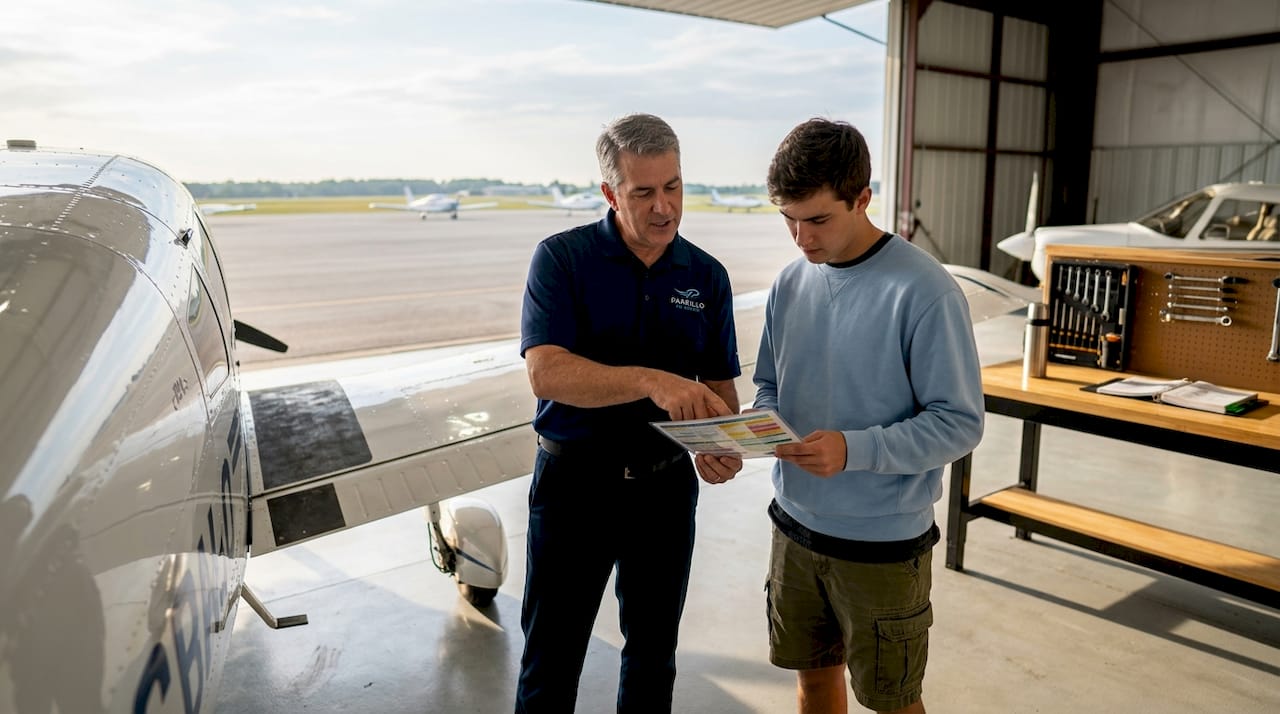
With the foundation set, let's walk step-by-step through what enrolling in flight training actually looks like, from your very first lesson to the moment you pass your checkride.
Flight training combines ground instruction, in-air flight lessons, and formal evaluations, all aligned to FAA standards. The sequence is logical and builds on itself, but many students underestimate how much preparation goes into each phase.
-
Ground school: This is where your aviation education begins. You'll study aeronautical knowledge including aircraft systems, meteorology, federal aviation regulations, navigation, and airspace. Ground school can be completed in person, online, or through a community college program. Expect to spend 40 to 60 hours here before your first solo flight.
-
Discovery flight: Most schools offer an introductory flight so you can experience the cockpit before committing. This is a short, instructor-led flight where you may even take the controls. It's a low-pressure way to confirm that aviation is the right path for you.
-
Dual flight instruction: Once enrolled, you'll fly regularly with a Certified Flight Instructor (CFI). These lessons cover pre-flight inspections, basic maneuvers, traffic pattern operations, and eventually cross-country navigation. Your instructor signs off on each skill as you demonstrate proficiency.
-
Simulator and AATD time: Advanced Aviation Training Devices (AATDs) are FAA-approved simulators that replicate cockpit instruments and flight conditions. They're especially valuable for instrument training, allowing you to practice approaches and procedures without burning fuel or depending on weather.
-
Solo flight milestones: After demonstrating sufficient skill, your instructor will endorse you for solo flight. Your first solo is a major milestone. You'll then build solo cross-country hours to meet FAA minimums.
-
FAA knowledge test: Before your checkride, you must pass the written knowledge test with a score of 70% or higher. Most students take this after completing ground school and before finishing all flight hours.
-
Checkride: The practical exam consists of an oral portion with a Designated Pilot Examiner (DPE) followed by a flight evaluation. The DPE tests you against the ACS standards. Pass both, and you receive your certificate.
Pro Tip: Start studying for your FAA knowledge test during your first few weeks of ground school, not after you finish flying. Students who study concurrently with their flight lessons retain information better and score higher on the written exam.
Part 141 vs Part 61: Choosing your training structure
Now that the training process is mapped out, it's time to decide which regulatory path is right for you. This decision will shape your timeline, your costs, and how much structure you'll have throughout training.
Part 141 flight schools operate under a structured, FAA-approved training program with a fixed syllabus, mandatory stage checks, and regular FAA auditing. Part 61 schools are more flexible, allowing instructors to customize lessons based on individual student progress and schedule.
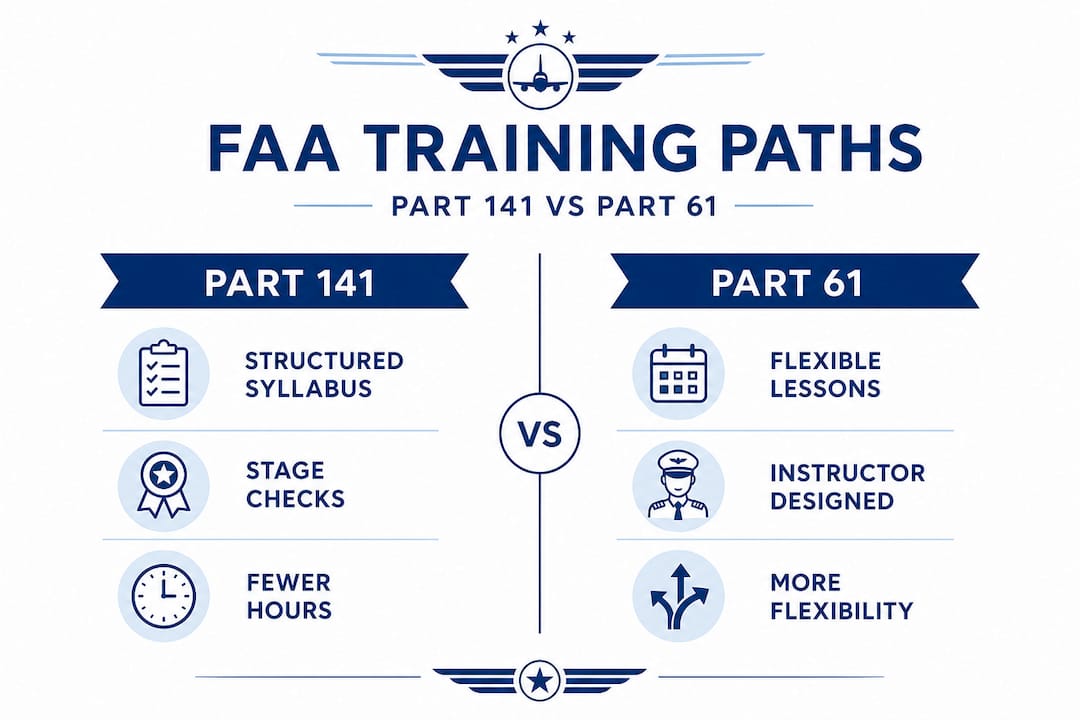
Here's a direct comparison to help you evaluate both options:
| Feature | Part 141 | Part 61 |
|---|---|---|
| Curriculum | FAA-approved, fixed syllabus | Instructor-designed, flexible |
| Minimum hours (Private) | 35 hours | 40 hours |
| Stage checks | Required at each stage | Not required |
| FAA oversight | Regular audits of school | Focused on individual student |
| Scheduling | Often rigid, cohort-based | Highly flexible |
| Best for | Students seeking structure | Working adults, career changers |
| Recordkeeping | School manages records | Student must self-track |
According to expert analysis of both paths, Part 141's structured model leads to more standardized outcomes, while Part 61 places greater responsibility on the student to self-advocate and stay on track. Neither is objectively better. They serve different types of learners.
Key factors to weigh when choosing your path:
- Career timeline: If you're targeting an airline career and want the most direct route, Part 141's stage-based structure keeps you accountable and moving forward.
- Schedule flexibility: If you're working full-time or have family commitments, Part 61 lets you train at your own pace without falling behind a cohort.
- Cost control: Part 61 can be more cost-effective if you're a fast learner, since you aren't locked into a rigid syllabus. But it requires discipline.
- Instructor relationship: Part 61 programs often offer a more personalized, one-on-one relationship with your CFI, which many students find motivating.
Pro Tip: Before enrolling anywhere, ask to see the school's syllabus or training outline. A well-organized Part 61 school will still have a clear progression plan. If a school can't show you a structured learning path, that's a red flag regardless of which part they operate under. You can review flight training program details to understand what a well-structured Part 61 program actually looks like in practice.
Specialized programs: Part 142 training centers and community college options
Besides the main Part 61 and Part 141 tracks, other structured learning opportunities exist, especially for specialized or local needs here in Virginia.
Part 142 training centers are a distinct category. These are FAA-evaluated facilities with rigorous curriculum oversight, typically used for advanced training such as type ratings (the certification required to fly a specific aircraft type) and airline transition programs. If you're already a certificated pilot looking to upgrade to a jet aircraft or complete airline-specific training, a Part 142 center is where that happens. These facilities often use full-motion simulators and are heavily integrated into airline hiring pipelines.
For students earlier in their journey, community college ground schools offer an affordable and academically structured way to meet FAA aeronautical knowledge requirements. Programs like the Virginia Highlands Private Pilot Ground School provide FAA-approved knowledge preparation in a classroom setting, often over a five-week intensive format. These programs are ideal if you want to complete ground school before committing to a full flight training program, or if you're working on a budget.
Here's how different program types compare on key metrics:
| Program type | Best stage | Avg. cost range | Flexibility | FAA oversight level |
|---|---|---|---|---|
| Part 61 | Private through CFI | Varies widely | High | Moderate |
| Part 141 | Private through ATP | Moderate to high | Low to moderate | High |
| Part 142 | Type ratings, ATP-CTP | High | Low | Very high |
| Community college ground school | Knowledge prep | Low | Moderate | Moderate |
Virginia students have a real advantage here. Local ground school options can satisfy the knowledge requirements for your FAA written test at a fraction of the cost of a full program. You can then apply that knowledge directly into advanced training centers or a local Part 61 school for your flight hours.
Why does this matter for your airline career? Airlines care about your total flight hours, your certificates, and your safety record. They don't typically distinguish between Part 61 and Part 141 graduates at the hiring stage. What they do care about is whether you meet the ATP (Airline Transport Pilot) minimums: 1,500 total flight hours for most candidates, or 1,000 hours if you graduated from a Part 141 school with an aviation degree. Choosing the right combination of programs from the start can meaningfully reduce your time to the airline cockpit.
Virginia flight training integration with local ground school options creates a practical, cost-conscious path that many aspiring pilots in the region are already using successfully.
What most aspiring pilots miss about flight training structure
Having examined all the program options, it's time for some straight talk about what really determines your flight training success. And it's probably not what you think.
Most students spend enormous energy comparing Part 141 versus Part 61, debating costs, and researching aircraft types. Very few spend enough time thinking about their own role in the process. Here's the uncomfortable truth: the structure of your program matters far less than your personal discipline, your recordkeeping habits, and your willingness to ask hard questions.
In Part 61 training especially, students must be proactive about meeting ACS standards on their own timeline. Your CFI will guide you, but no one will chase you down to make sure your logbook is accurate, your endorsements are complete, or that you've reviewed the correct ACS areas before your checkride. That responsibility is yours.
We've seen students in highly structured programs stumble at the checkride because they treated training as a checklist rather than a genuine learning process. We've also seen Part 61 students thrive because they treated every lesson as an opportunity to close a knowledge gap. The program type sets the environment. You set the outcome.
What actually moves the needle in flight training:
- Detailed logbook records: Every flight, every maneuver, every ground session. Gaps in your logbook create problems at checkrides and airline interviews.
- Honest self-assessment: After every lesson, ask yourself what you didn't fully understand. Then address it before the next flight, not the night before your checkride.
- Proactive communication with your CFI: The best student-instructor relationships are collaborative. Ask for feedback, request extra practice on weak areas, and don't wait for your instructor to notice a problem.
- Exploring all available pathways: Community college ground schools, online knowledge prep, simulator practice, and mentorship from working pilots all supplement your formal training in ways that accelerate your progress.
Certified instruction at Parrillo Air is built around this philosophy. Personalized instruction means your CFI is paying attention to your specific gaps, not just moving you through a syllabus. That relationship is the single biggest variable in how quickly and confidently you'll reach your goals.
Next steps: Start your flight training journey
Armed with this understanding, you're ready to take the next step toward your pilot career.
At Parrillo Air Services in Lynchburg, VA, we work with aspiring pilots at every stage, from students who've never sat in a cockpit to those building hours toward their commercial certificate. Our Part 61 approach means your training is built around your schedule, your learning pace, and your specific career goals.
Explore flight training program information to review course options, program requirements, and what to expect from your first lesson through your checkride. Whether you're ready to schedule a discovery flight or just want to ask a few questions, Parrillo Air Services in VA is here to help you move from curious to certificated. Reach out today and let's build your aviation career together.
Frequently asked questions
What is the difference between Part 141 and Part 61 flight schools?
Part 141 schools follow an FAA-approved structured curriculum with required stage checks, while Part 61 schools offer more flexibility, letting instructors tailor lessons to individual student needs and schedules.
Do I need a college degree to become a pilot in Virginia?
No, a college degree is not required for an FAA pilot certificate, but community college programs and some airline pathways may offer meaningful career advantages for those who pursue additional education.
How many hours are required for a private pilot certificate?
FAA minimums are 40 hours under Part 61 and 35 hours under Part 141, though most students realistically need 55 to 70 hours to meet the practical standards required for a checkride.
Can I use a flight simulator for FAA training credit?
Yes, AATD simulator time is permitted for a portion of required training hours if the device is FAA-approved and the time is logged correctly under your specific certificate requirements.
Are there local options for ground school in Virginia?
Yes, Virginia colleges offer ground schools that satisfy FAA aeronautical knowledge requirements, often in an intensive five-week format that prepares you for the FAA written knowledge test.