
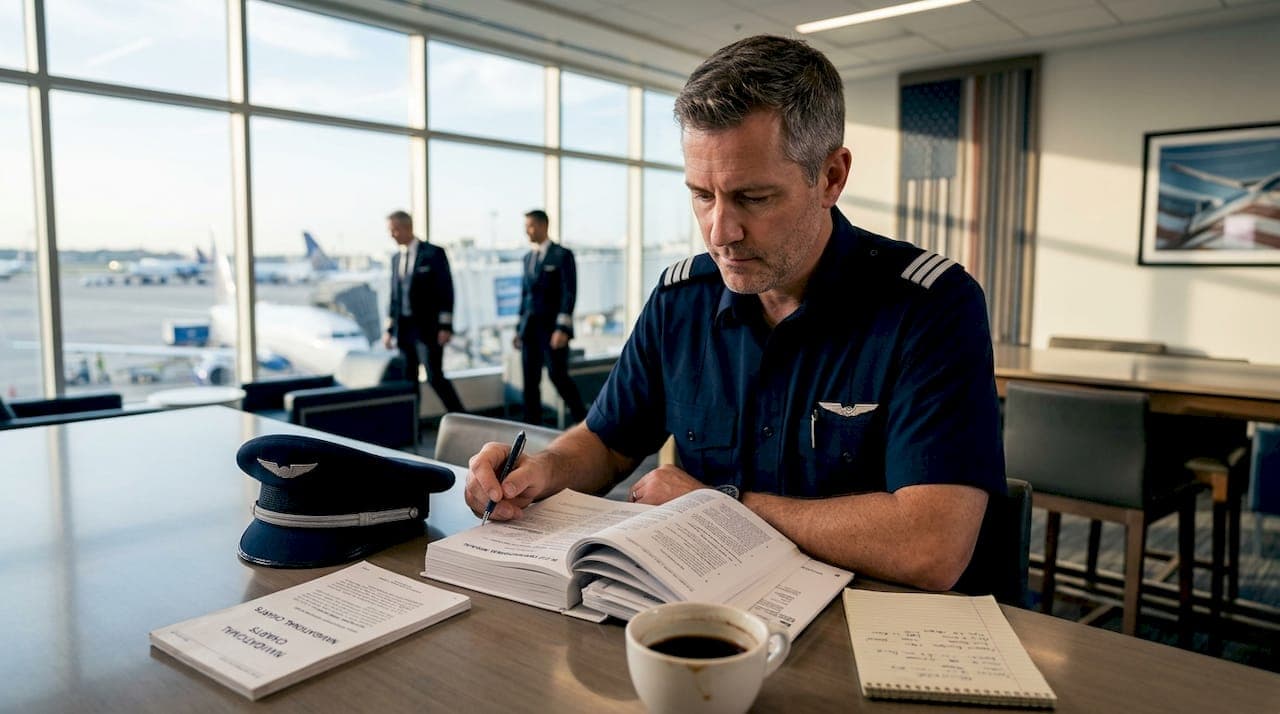
Many aspiring pilots spend years working toward a commercial pilot certificate, believing it's the final credential standing between them and an airline cockpit. It isn't. The Airline Transport Pilot (ATP) certificate is the FAA's highest level of pilot certification, and without it, you cannot legally serve as a captain or first officer for a scheduled airline in the United States. Understanding the difference between these two credentials, and knowing exactly how to earn the ATP, can reshape your entire career strategy from day one.
Table of Contents
- What is an Airline Transport Pilot (ATP)?
- ATP certificate requirements and types
- Why the ATP certificate is essential for airline careers
- ATP privileges, limitations, and operational nuances
- The real value of the ATP: What most aspiring pilots miss
- Your next step: Start the journey to ATP certification
- Frequently asked questions
Key Takeaways
| Point | Details |
|---|---|
| ATP is top FAA license | The ATP certificate is required for airline captain and first officer positions in the U.S. |
| Strict training required | Earning an ATP involves FAA-approved training, knowledge, and experience beyond commercial pilot level. |
| Restricted vs. unrestricted | The restricted ATP limits certain airline roles until full experience is gained. |
| Privileges can have limits | Some instructor and operational privileges require extra qualifications even for ATPs. |
| Strategic career move | Earning an ATP opens doors to airline careers and faster advancement. |
What is an Airline Transport Pilot (ATP)?
The ATP certificate sits at the top of the FAA's pilot certification hierarchy. Think of it like a medical specialty license compared to a general practitioner's degree. A commercial certificate lets you fly for hire. An ATP lets you command or serve as a key crew member on the aircraft that carry hundreds of thousands of passengers every day across the country.
According to 14 CFR 61.167, the ATP is the FAA's highest level of pilot certification and carries airline-appropriate privileges and limitations. This regulation defines exactly what an ATP holder can and cannot do, covering everything from acting as Pilot-in-Command (PIC) on large transport-category aircraft to specific instructor roles.
Here is what the ATP certificate covers in practice:
- Pilot-in-Command authority on air carrier aircraft operating under Part 121 (scheduled airline operations)
- First Officer (Second-in-Command) roles on scheduled airline flights
- Cargo and freight carrier operations requiring ATP-level certification
- Charter and on-demand air carrier positions where regulations specify ATP
- Flight instruction in certain advanced categories, subject to additional requirements
"The ATP certificate isn't just a credential upgrade. It's the legal key that unlocks the cockpit door of every major and regional airline in the United States. Without it, no amount of flight hours or experience will get you into the left seat of a Part 121 aircraft."
The ATP also comes with age requirements. You must be at least 23 years old for an unrestricted ATP, though a restricted version is available at a younger age under specific conditions. This age and experience framework exists because the FAA recognizes that commanding a passenger jet demands a level of maturity and accumulated judgment that simply takes time to develop.
ATP certificate requirements and types
Having defined the ATP, it's important to see what it takes to get one and how different versions can affect your career timeline.
The ATP qualification process includes an FAA-required ATP Certification Training Program (ATP-CTP) before you take the ATP knowledge test for the multi-engine ATP written exam. This is a mandatory ground and simulator training course that covers advanced aerodynamics, meteorology, aircraft systems, air carrier operations, and crew resource management. You cannot sit for the ATP knowledge test without completing it first.
Here is the step-by-step path to earning a full, unrestricted ATP:
- Hold a commercial pilot certificate with an instrument rating
- Meet the minimum flight experience of 1,500 total flight hours
- Complete an FAA-approved ATP-CTP course covering required academic and simulator training
- Pass the ATP knowledge test (written exam)
- Meet the age requirement of at least 23 years old
- Pass the ATP practical test (checkride) with an FAA examiner
Now, the picture gets more nuanced with the restricted ATP, known as the R-ATP. A restricted-privileges ATP exists which changes minimum aeronautical experience and age requirements, and restricts privileges, notably Pilot-in-Command capability, until full ATP requirements are met. The R-ATP allows qualified candidates to serve as a first officer on Part 121 airlines before reaching the 1,500-hour mark, but it comes with real limitations you need to understand before choosing this path.
| Feature | Unrestricted ATP | Restricted ATP (R-ATP) |
|---|---|---|
| Minimum age | 23 years | 21 years |
| Minimum flight hours | 1,500 | 1,000 to 1,250 (pathway dependent) |
| PIC authority (Part 121) | Yes | No |
| SIC authority (Part 121) | Yes | Yes |
| Military pathway eligible | Yes | Yes (reduced to 750 hours) |
| University aviation program | Yes | Yes (reduced to 1,000 hours) |
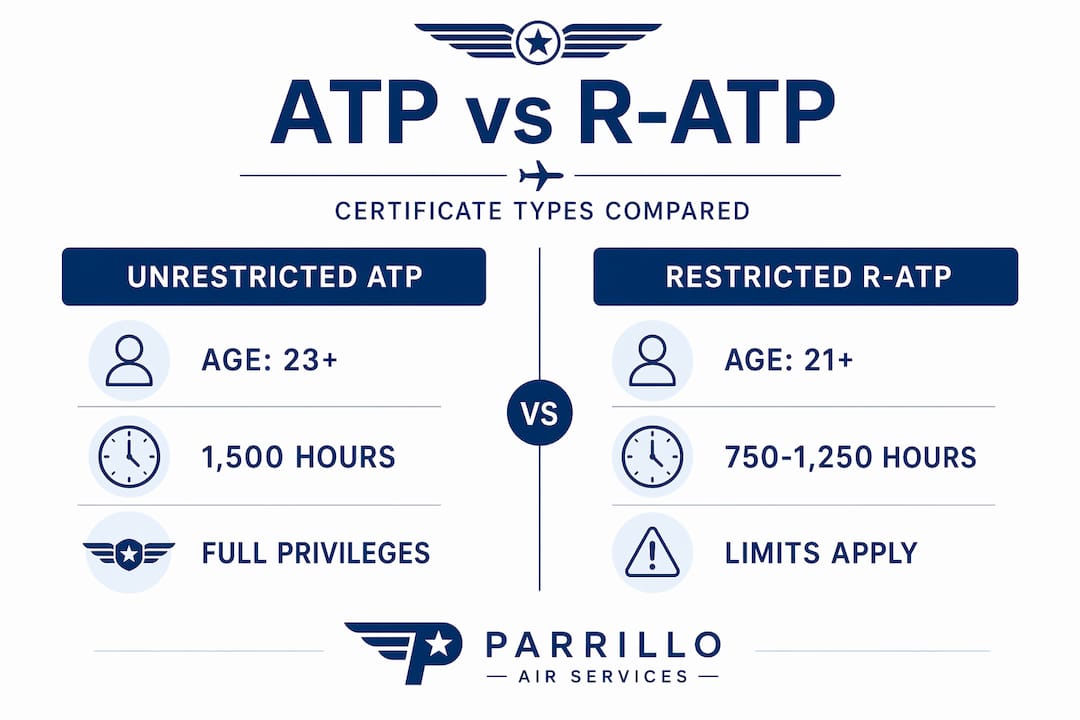
The R-ATP is available through three primary pathways. Military pilots can qualify with as few as 750 hours. Graduates of certain four-year aviation university programs can qualify at 1,000 hours. Graduates of two-year aviation programs at accredited institutions can qualify at 1,250 hours. Everyone else needs the full 1,500 hours for any ATP-level certificate.
Pro Tip: If you are currently in a Part 61 training program, every hour you log matters strategically. Track your cross-country time, night hours, and instrument hours carefully because all of these feed into your ATP eligibility. Review the ATP-CTP requirements early so you know exactly what boxes you need to check before your 1,500-hour mark arrives.
Why the ATP certificate is essential for airline careers
Knowing the requirements, let's look at why the ATP certificate is so critical for airline aspirations and what it means in the hiring process.
The ATP is required for captain and first officer roles in Part 121 airline operations. This is not a preference or a soft requirement that airlines can waive. It is federal law. Every major airline, every regional carrier, and every scheduled air carrier operating under Part 121 must have ATP-certified pilots in the cockpit. Period.
Here is what that means in practical hiring terms:
- Regional airlines hiring first officers require at minimum an R-ATP, but many prefer candidates with or close to unrestricted ATP status
- Major airlines (think the largest carriers by fleet size and routes) almost universally require the full, unrestricted ATP before a pilot even gets an interview
- Cargo carriers operating large aircraft under Part 121 follow the same ATP requirements as passenger airlines
- Promotions from first officer to captain require the unrestricted ATP, so even if you are hired with an R-ATP, you cannot upgrade to captain without meeting full ATP standards
The distinction between unrestricted and restricted ATP matters enormously during hiring and promotion cycles. Airlines invest heavily in training new pilots, and they pay close attention to how quickly a new hire can progress toward captain eligibility. A candidate with an unrestricted ATP signals readiness. A candidate with an R-ATP signals potential but also signals that a legal ceiling exists on their current role.
| Career milestone | ATP requirement |
|---|---|
| Regional airline first officer | R-ATP minimum |
| Major airline first officer | Unrestricted ATP preferred |
| Regional airline captain | Unrestricted ATP required |
| Major airline captain | Unrestricted ATP required |
| Cargo carrier (Part 121) | ATP required |
Understanding the corporate airline transport context also helps frame why ATP certification carries so much weight. Air transport operations, whether commercial or cargo, operate within strict regulatory frameworks that prioritize safety above all else. The ATP requirement exists precisely because these operations carry significant public responsibility.
For pilots who want to explore flight training pathway information and understand how to align their training with ATP eligibility, getting clear on these distinctions early saves years of frustration later.
ATP privileges, limitations, and operational nuances
With the importance established, it's critical to understand exactly what privileges the ATP confers and where even ATP holders must check for regulatory limits.
A full, unrestricted ATP grants you broad authority in the cockpit. Here is what you can do:
- Act as Pilot-in-Command on any aircraft for which you hold the appropriate type rating
- Serve as Second-in-Command on Part 121 operations
- Provide flight instruction in categories and classes where you hold appropriate ratings, subject to additional requirements
- Exercise all commercial pilot privileges since the ATP encompasses all lower certificate privileges
However, the R-ATP comes with a significant and non-negotiable restriction. You cannot act as Pilot-in-Command of a Part 121 aircraft. You can fly as a first officer, gain experience, and build toward the unrestricted ATP, but the captain's seat is legally off-limits until you satisfy every requirement for the full certificate. This is not a technicality that airlines overlook. It is enforced.
Beyond the R-ATP restrictions, even full ATP holders encounter operational limits that surprise some pilots. Per 14 CFR 61.167, even with an ATP certificate, instructors and certain operational roles are constrained by regulation and may require additional training or testing for specific categories of operations, such as Category II and Category III instrument approaches.
Category II and III approaches involve flying to extremely low visibility minimums, sometimes down to zero visibility for Category III. Instructing pilots in these procedures requires specific authorization beyond the ATP certificate itself. This is a detail that catches some newly certified ATP holders off guard.
Pro Tip: When you earn your ATP, do not assume your learning is finished. The most career-ready pilots continue building type ratings, instrument proficiency, and operational authorizations well after earning the certificate. Airlines notice candidates who invest in ongoing proficiency, not just those who hit the minimum threshold and stop.
Additional nuances worth knowing: certain aircraft categories require separate ATP testing. A multi-engine ATP does not automatically grant ATP-level privileges in single-engine aircraft. Each category and class requires its own qualification, which is why most airline-track pilots focus their ATP training on multi-engine aircraft from the beginning.
The real value of the ATP: What most aspiring pilots miss
Now that you have a full understanding of the ATP's requirements and limitations, let's step back and look at how successful pilots think about the certification.
Here at Parrillo Air Services, we see a consistent pattern among aspiring airline pilots. They focus intensely on passing tests and logging hours, treating the ATP as a finish line rather than a starting block. That mindset is understandable, but it costs pilots in ways they do not realize until they are deep into their careers.
The ATP is strategic access, not just a credential. The difference between an R-ATP and an unrestricted ATP is not merely 500 hours of flight time. It is the difference between being captain-eligible on day one of a new airline job versus spending additional years as a first officer before you can even be considered for upgrade. At major airlines, captain upgrades can take a decade or more even with an unrestricted ATP. Starting with an R-ATP adds time to that clock.
We also see pilots underestimate how much hiring managers look beyond the certificate itself. Yes, you need the ATP to get in the door. But the pilots who advance fastest are those who accumulated their hours strategically, in complex aircraft, in challenging conditions, with diverse operational experience. A pilot who logged 1,500 hours in a variety of aircraft and environments tells a more compelling story than one who built hours in the simplest possible way just to hit the number.
The choice of training pathway also matters more than many pilots realize early on. Military service, university aviation programs, and civilian Part 61 training each produce ATP-eligible pilots, but they produce different kinds of pilots with different experience profiles. There is no universally "best" path, but there is a best path for your specific goals, timeline, and resources. Planning that path early, ideally before you even start flight training, gives you a significant head start.
The pilots who reach major airline captain seats fastest are not always the ones who flew the most hours. They are the ones who flew the right hours, earned the right ratings in the right sequence, and positioned themselves as ready for every step before the airline even asked.
Your next step: Start the journey to ATP certification
Armed with knowledge, it's time to turn understanding into action.
At Parrillo Air Services in Lynchburg, VA, we work with pilots at every stage of the journey toward ATP certification. Whether you are just starting out or building toward the ATP-CTP and your final checkride, our FAA Part 61 training programs are designed to put you on the most direct path to airline readiness. We help you log the right hours, build the right skills, and understand exactly where you stand in relation to ATP eligibility at every step.

Explore our pilot training options to see how we structure training from private pilot all the way through commercial and instrument ratings, leading directly toward ATP qualification. Our instructors have real-world airline experience and know what hiring managers actually look for. Visit Parrillo Air Services to learn more about our programs, ask questions, or schedule your first flight. The ATP is within reach. Let's build the plan to get you there.
Frequently asked questions
What is the difference between a commercial pilot and an Airline Transport Pilot (ATP)?
A commercial pilot can fly for hire in many roles, but only an ATP holder can legally serve as captain or first officer for scheduled airlines. The ATP is the FAA's highest level of pilot certification, carrying privileges that a commercial certificate simply does not include.
Can you act as a captain for an airline with a restricted ATP (R-ATP)?
No. R-ATP restrictions prevent acting as Pilot-in-Command of Part 121 aircraft until full ATP experience and age standards are met, so the captain's seat remains off-limits until you earn the unrestricted certificate.
What training is required before I can take the ATP written exam?
You must complete an FAA-approved ATP-CTP before sitting for the ATP knowledge test. The ATP-CTP is required prior to the ATP knowledge test and covers advanced aerodynamics, air carrier operations, and simulator training.
Do all airline pilot jobs in the U.S. require an ATP?
Most captain and first officer roles with scheduled airlines require an ATP by federal regulation. ATP is required for captain and first officer positions in Part 121 airline operations, though some entry-level or non-Part 121 roles may differ.
Does holding an ATP allow you to instruct in all airline operations?
No. Category II/III instruction requires additional training and testing even for ATP holders, so specific operational roles carry their own authorization requirements beyond the certificate itself.