

The airline pilot interview is one of the most high-stakes moments in any aviator's career. You've logged the hours, earned your ratings, and built real experience in the cockpit, yet the interview room can feel like an entirely different kind of challenge. The difference between candidates who get the call back and those who don't almost always comes down to preparation. This guide walks you through every critical step, from understanding what airlines look for to refining your answers and tracking your growth after each interview, so you walk in with confidence and walk out with an offer.
Table of Contents
- Understanding what airlines look for
- Gathering your application materials
- Mastering interview scenarios and questions
- Avoiding common pitfalls and elevating your performance
- Tracking your progress and reflecting after interviews
- A veteran pilot's perspective: what most candidates miss about interview prep
- Advance your pilot career with expert guidance
- Frequently asked questions
Key Takeaways
| Point | Details |
|---|---|
| Know airline priorities | Airlines value technical expertise, sound judgment, and strong soft skills in pilot candidates. |
| Prepare all documents | Organized and complete application materials are crucial for making a professional impression. |
| Practice interview scenarios | Rehearsing technical, HR, and scenario-based questions dramatically boosts confidence and performance. |
| Learn from experience | Reflecting after each interview helps you adapt and improve for future opportunities. |
| Avoid common pitfalls | Awareness of typical mistakes allows you to present yourself as a polished, standout candidate. |
Understanding what airlines look for
Now that you know why preparation matters, let's start by understanding what airlines actually want from their next pilot.
Airlines are not simply hiring someone who can fly a plane. They are selecting a professional who will represent their brand, protect their passengers, and operate safely under pressure for decades. That means the bar is high on both the technical and human sides of the equation. Understanding pilot hiring requirements before you apply gives you a real edge in tailoring your preparation.
The five competencies airlines value most are:
- Technical knowledge: Demonstrated mastery of aircraft systems, regulations, and procedures.
- Situational awareness: The ability to read and respond to evolving conditions in real time.
- Crew resource management (CRM): How well you communicate and collaborate in a multi-crew environment.
- Decision-making under pressure: Sound judgment when time and information are limited.
- Professionalism and attitude: How you carry yourself, take feedback, and represent the airline.
Here's a quick comparison of the quantitative and qualitative requirements most airlines use during the hiring process:
| Requirement type | Examples | Why it matters |
|---|---|---|
| Quantitative | Total flight hours, ATP certificate, medical class | Establishes baseline eligibility |
| Qualitative | Communication style, leadership, adaptability | Determines cultural and operational fit |
| Regulatory | FAA certifications, type ratings, recency | Ensures legal compliance to fly |
| Background | Clean record, references, employment history | Builds trust and reduces liability |
Pro Tip: Before your interview, spend at least two hours researching the specific airline. Study their fleet, routes, company values, and recent news. Interviewers notice when a candidate speaks specifically about the airline rather than giving generic answers that could apply to anyone.
Gathering your application materials
Once you understand what airlines seek, your next step is to prepare your application so you make a strong first impression even before the interview.
Your paperwork tells your story before you say a single word. A disorganized or incomplete application packet signals carelessness, and in aviation, carelessness is a serious red flag. Following compliance requirements for pilot applicants ensures you don't miss anything critical.
Here is a breakdown of the essential documents and how to present each one:
| Document | Format | Presentation tip |
|---|---|---|
| Pilot resume | One to two pages, clean layout | Tailor it to each airline; highlight relevant aircraft types |
| Pilot logbook | Original plus digital backup | Ensure all entries are accurate, legible, and totaled correctly |
| FAA certificates | Originals and certified copies | Keep in a protective sleeve; never submit originals alone |
| Medical certificate | Current first-class | Check expiration dates well in advance |
| Reference letters | Signed, on letterhead | Choose references who can speak to your airmanship and character |
| Training records | Simulator completions, checkrides | Include dates and outcomes; note any additional endorsements |
Follow these steps to assemble a professional application packet:
- Gather all documents at least three weeks before the application deadline, giving yourself time to address any gaps.
- Review your logbook carefully for math errors, missing signatures, or incomplete entries. Even small discrepancies can raise questions.
- Update your resume to reflect your most recent hours, ratings, and any leadership or instructing experience.
- Request reference letters early because professional contacts need time to write thoughtful, specific letters.
- Create a master folder, both physical and digital, organized by document type so you can produce anything instantly during the interview.
- Do a final audit 48 hours before submission. Cross-check every document against the airline's stated requirements.
One of the most common mistakes candidates make is submitting logbooks with uncorrected errors or totals that don't add up. Interviewers and chief pilots review these carefully. Another frequent problem is using a generic resume that lists hours but fails to describe the kind of flying you've done. Be specific. "1,200 hours of Part 135 charter operations in mountainous terrain" tells a much richer story than "1,200 total flight hours."
Mastering interview scenarios and questions
With your paperwork in hand, your focus turns to the heart of interview preparation: practicing for what you'll be asked.
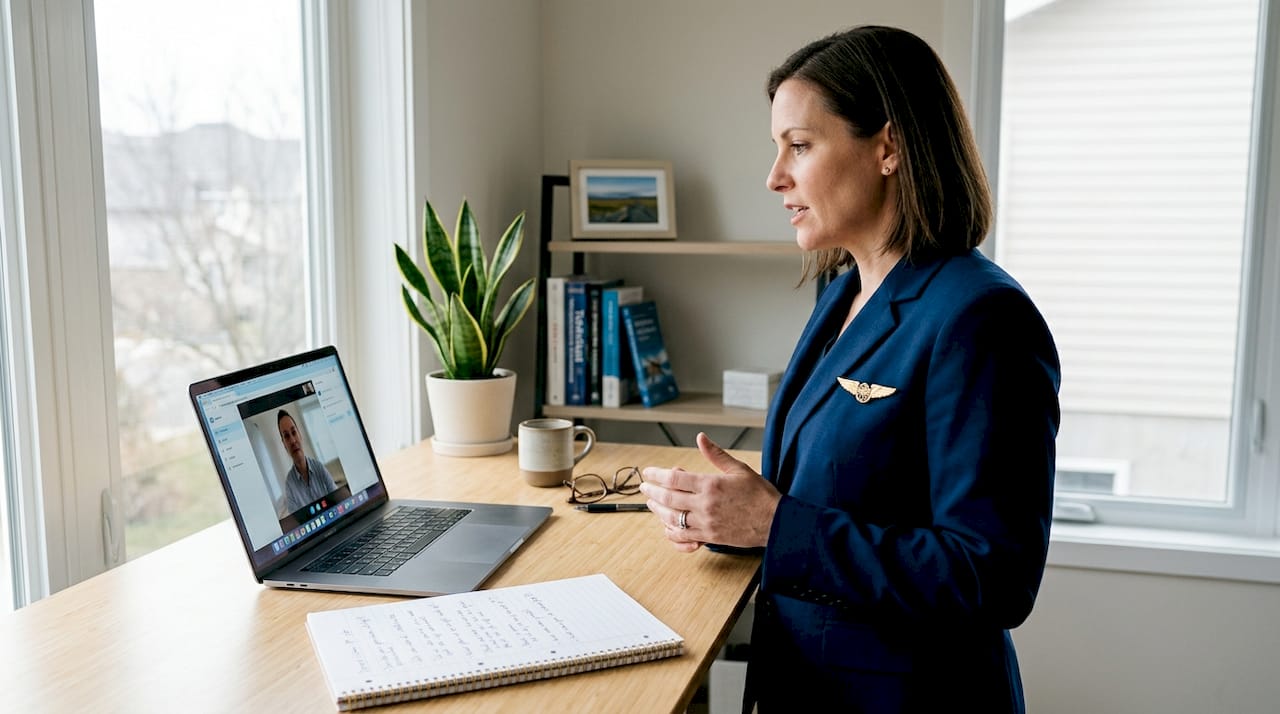
Airline pilot interviews typically include three distinct components. Each one tests a different dimension of your readiness, and each requires a different preparation strategy.
Technical questions assess your knowledge of aircraft systems, regulations, weather, and procedures. Expect questions like "Walk me through your engine-out procedure" or "What are the VFR weather minimums for Class C airspace?" These questions have right and wrong answers, so study your aircraft operating handbooks and the FAR/AIM thoroughly.
Scenario-based questions present a realistic situation and ask how you would respond. For example: "You're on approach and your first officer disagrees with your decision to continue. What do you do?" These questions test your judgment, CRM skills, and ability to stay calm under pressure.
HR and personality questions explore who you are as a person and a professional. "Tell me about a time you made a mistake and what you learned" or "Why do you want to fly for us specifically?" are common examples.
Here are the top five question types you should prepare for, with sample approaches:
- Strength and weakness questions: Be honest and frame weaknesses as areas of active growth. Avoid clichés like "I work too hard."
- Conflict resolution questions: Describe a real situation where you navigated disagreement respectfully and professionally.
- Safety judgment questions: Always prioritize safety in your answer, even if it means making an unpopular call.
- Career motivation questions: Connect your personal aviation journey to the specific airline's mission and values.
- Regulatory knowledge questions: Brush up on recent FAA rule changes and be ready to cite specific FARs.
Pro Tip: Use the STAR method (Situation, Task, Action, Result) when answering behavioral questions. It keeps your answer structured, concise, and memorable. Practice it out loud until it feels natural rather than rehearsed.
"Every answer you give in an airline interview should reflect a pilot who puts safety and sound judgment first. Interviewers are not just listening to what you say. They are evaluating how you think." This is the standard that separates candidates who pass from those who don't. You can find more pilot interview preparation strategies by exploring resources built specifically for aspiring airline pilots.
Avoiding common pitfalls and elevating your performance
Knowing the types of questions is only half the battle. To truly excel, avoid common traps and know how to showcase your strengths.
Many candidates walk into airline interviews well-prepared on paper but stumble on execution. Here are the most frequent mistakes and how to sidestep them:
- Talking too much or too little: Aim for clear, complete answers that last 60 to 90 seconds for behavioral questions. Rambling signals poor communication skills; one-word answers signal disengagement.
- Failing to demonstrate CRM awareness: Airlines operate on crew coordination. If your answers always make you the lone hero, that's a problem.
- Neglecting non-verbal communication: Slouching, avoiding eye contact, or fidgeting all undermine the confidence you've built through preparation.
- Being unprepared for the "tell me about yourself" opener: This is your personal narrative. Practice a 90-second version that covers your aviation journey, key experiences, and why you're sitting in that chair.
- Ignoring the waiting room: Some airlines have interviewers observing candidates in the lobby. How you treat staff, other candidates, and administrative personnel matters more than you think.
- Skipping the mental preparation: Interview anxiety is real. Develop a pre-interview routine that includes sleep, light exercise, and a review of your key talking points the night before.
For physical and mental readiness on interview day, plan to arrive at least 30 minutes early, wear professional attire appropriate for the airline's culture, and eat a light meal beforehand. Avoid caffeine overload, which can amplify nerves. Bring printed copies of all your documents even if you submitted them digitally.
You can also explore flight training insights that speak directly to the professional habits that make pilots stand out throughout their entire career, not just during interviews.
Pro Tip: Send a brief, personalized thank-you email within 24 hours of your interview. Reference something specific from the conversation to show genuine engagement. Very few candidates do this, and it leaves a lasting impression.
Tracking your progress and reflecting after interviews
Excelling in airline pilot interviews is an iterative process. Your learning doesn't end after one conversation. It continues with self-reflection.
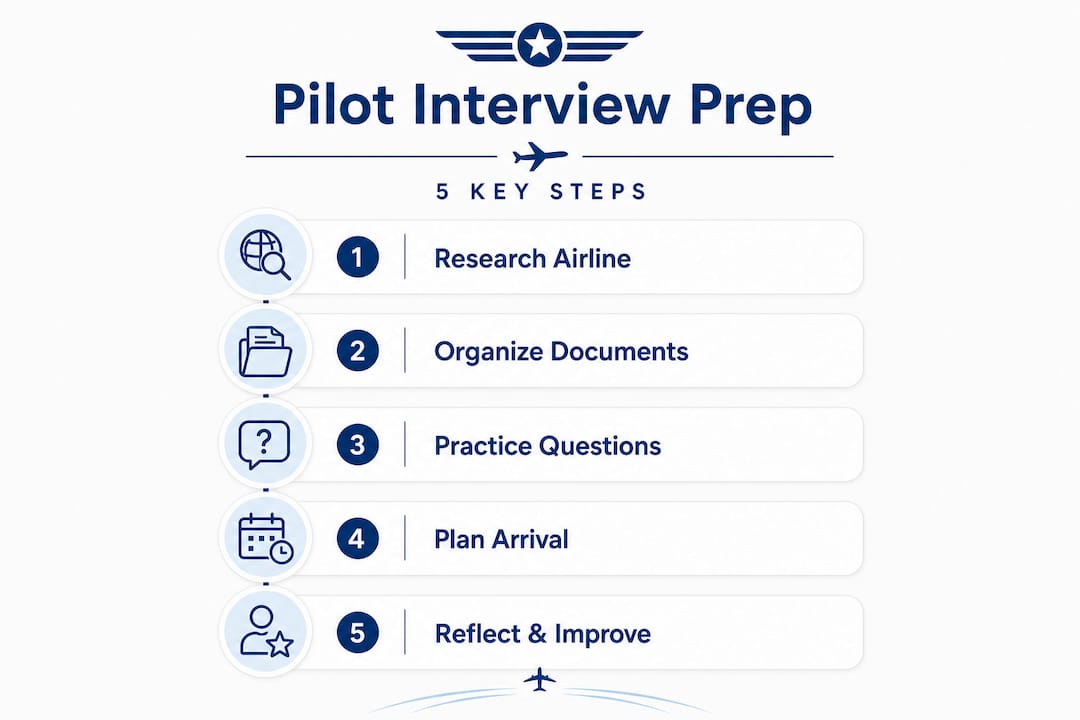
Most pilots treat each interview as a standalone event. The ones who land positions quickly treat every interview as a data point in a longer learning curve. Building a feedback log is one of the most underused and most effective tools available to you.
After each interview, ask yourself:
- Which questions caught me off guard, and why?
- Where did I feel most confident, and what made those moments work?
- Did I demonstrate sound judgment and safety awareness consistently?
- Was there a moment where I talked too long or lost my train of thought?
- How well did I connect my experience to the airline's specific needs?
Here's how strong and weak post-interview reflection approaches compare:
| Reflection approach | Strong | Weak |
|---|---|---|
| Timing | Within 24 hours while details are fresh | Days later when memory fades |
| Method | Written log with specific notes | Mental review only |
| Focus | Specific questions and responses | General impressions |
| Action | Adjust preparation based on findings | No changes to preparation |
| Mindset | Growth-oriented, honest self-assessment | Defensive or dismissive |
The goal is to build a career through consistent improvement, not to treat each opportunity as pass or fail. Pilots who reflect seriously after interviews often report that their second and third interviews feel dramatically more natural than their first, even when the questions are harder.
A veteran pilot's perspective: what most candidates miss about interview prep
You've learned the essential steps. Now, here's what most pilot hopefuls usually overlook, straight from the perspective of an industry veteran.
The biggest mistake we see is over-rehearsing. Candidates spend hours memorizing scripted answers and then deliver them with all the warmth of a recorded announcement. Interviewers have heard thousands of polished responses. What they remember are the candidates who spoke like real human beings.
Humility is massively undervalued. When you're asked about a mistake or a difficult situation, the instinct is to minimize or redirect. Resist that. A pilot who says "I got it wrong, here's exactly what I learned, and here's how I fly differently now" demonstrates the self-awareness that makes a great crew member. That's far more compelling than a perfect answer that never acknowledges a flaw.
Adaptability matters too. If an interviewer pushes back on your answer, don't crumble and don't dig in stubbornly. Engage with the challenge. Ask a clarifying question. Think out loud. Show them how you process new information in real time, because that's exactly what you'll do at 35,000 feet.
And here's the tip that changes everything: treat the interview like a two-way conversation. You are also evaluating whether this airline is the right fit for your career and values. When you approach it that way, your body language shifts, your answers become more genuine, and you come across as a confident professional rather than a nervous applicant. Explore expert pilot insights to keep building that professional mindset long after the interview is over.
Advance your pilot career with expert guidance
If you're ready to take the next step in launching your airline pilot career, robust support and guidance make all the difference.
At Parrillo Air Services, we train pilots from their very first discovery flight through commercial and flight instructor certifications, with a clear focus on building the skills and professionalism that airlines actually hire. Our instructors understand what the industry demands because they've been there. Explore our detailed flight training programs to see how structured, personalized instruction prepares you for every stage of your aviation career. When you're ready to dig into tools, resources, and ongoing support as a student, our student support resources are built to keep you on track from ground school to the airline interview room.
Frequently asked questions
What documents should I bring to an airline pilot interview?
Bring your updated resume, pilot's license, logbooks, medical certificate, and recommendation letters, all organized and easy to present. Review the required documents checklist specific to each airline before your interview date.
How should I prepare for technical questions in pilot interviews?
Review recent flight scenarios, FAA regulations, and aircraft systems, then practice answering out loud to build fluency and confidence. Focused study on interview preparation strategies will help you anticipate the specific technical areas interviewers target most.
What are the most common mistakes in airline pilot interviews?
Common mistakes include incomplete paperwork, poor communication, and failing to demonstrate sound judgment in scenario-based questions. Reviewing common interview errors early in your preparation helps you eliminate these issues before they cost you an offer.
How important are soft skills in the pilot interview process?
Soft skills like communication, adaptability, and decision-making carry equal or greater weight than technical knowledge in most airline hiring decisions. Airlines know they can teach procedures, but they can't easily teach the value of soft skills that make a great crew member.